
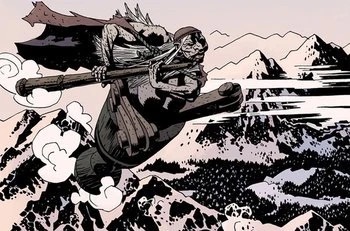
If you find yourself on the narrow path through the dark forest, whether by choice or force, you will certainly encounter Baba Jaga, that great and terrible witch of Slavic lore. They say that she is a powerful storm, stirring up the blizzard with her crooked broom. They say that she rides through the night in an iron-lined mortar and pestle, an image so absurd and jarring that it conjures a terrifying frisson. Her voice is tinged with rooster blood dragged from the dark mountain, her words crackle with lightning and death shudder. Her nightmarish hut stands on vast, scaly chicken legs, always turning, always facing the darkest part of the forest. Baba Jaga is constant movement – the wisdom of the swirling storm, not the still lake.
Is she evil? Perhaps. She does eat children, after all. But surely too she is beyond evil. She is the embodiment of the wilderness, the undomesticated, the primal, instinctual parts of ourselves that exist outside of polite society, beyond the sturdy cattle of the field and the twinkling lights of the warm inn.
Mikhail Chulkov hints at Baba Jaga’s dual nature – nightmare and nurturer – noting similarities with the early Slavic goddess of death known as Iagaia Baba, who lactated rain from her breasts:
The Slavs venerated the underworld goddess by this name, representing her as a frightening figure seated in an iron mortar, with an iron pestle in her hands; they made blood sacrifice to her, thinking that she fed it to the two granddaughters attributed to her, and that she delighted in the shedding blood herself.
Mikhail Chulkov
Baba Jaga is wrapped in this essential and alluring ambiguity. Like the storm that some say gave birth to her, she can be life-giving and also life-taking. She is death in service to life. She is a fierce and ancient feminine wisdom. Some mythologists say that she is a form of the great Earth Mother, born of the universe itself. Some say that she is the great Devourer, ready to consume all of creation if we are stupid enough to squander it.
Above all, Baba Jaga is an agent of transformation. To navigate her forest pathways, to make a dark ally of the great witch, is a goal of initiation. In Veronica Roth’s When Among Crows, Dymitr is on the initiatory path, not his false initiation into the Knights of the Holy Order, but his true initiation into deeper, truer life – burning the old script, cauterizing the wounds, cooking in the fires. He must, as Lorca would say, get down on all fours and eat the grasses of the cemetery. And so Babcia appears…
Will she help or will she harm? To stand before Baba Jaga is to be tested. She needs to see mettle and wit and ferocity. You better gleam with old intelligence or she will gobble you up and grind your bones between her teeth.
Baba eats naïve people, people who think life should only bring them happiness. To the uninitiated, suffering is not acceptable. Their thinking is dualistic—white or black, good or evil, science or religion. Their masculinity and femininity are nowhere near the inner marriage.
Marion Woodman
An audience with Baba Jaga is to stand at the Portal. You must discern, and you better do it quickly. Will you squeeze through, battered and torn, will you walk through death into the initiated life? Or will you fall out of your own story?
Will Dymitr squeeze through? To do so, he will have to enter his own wound. It’s a harsh journey, Babcia. But if he makes it, he will emerge with a sheen of that old consciousness, properly smoked, if you will. From the wound, the wild roses grow.
Johns, A. Baba Yaga: The Ambiguous Mother and Witch of the Russian Folktale. Peter Lang Inc., International Academic Publishers, 2004.
Shaw, M. A Branch from the Lightning Tree: Ecstatic Myth and the Grace of Wildness. White Cloud Press, 2011.
– CR

 The Book Club of the Apocalypse.
Leave a comment